
How to Order a Shipping Container Online: 7 Steps
Ordering a shipping container online takes seven steps: define the job, choose size and condition, gather the details a seller needs for a quote, compare the total price, vet the seller and terms, confirm local rules, and schedule delivery to a prepared site. Done in that order, most orders are completed in a single sitting, and the surprises (a truck that cannot reach the pad, a permit nobody checked) are caught before you pay.
This guide is written for businesses, contractors, event teams and institutions that need a container for storage, a jobsite office or cold storage, and want to buy or rent without a week of phone calls.
TL;DR
- Decide the use first (dry storage, office, cold storage, hazmat), because it sets the size, condition and modifications you need.
- A quote is only accurate with a delivery address, a placement description and the modifications listed up front.
- Budget for more than the box: purchase prices, freight and site preparation each move the total.
- Check zoning and permits before you order, since rules differ by city and county.
- Confirm truck access and a firm, level pad before the delivery date is booked.
Table of Contents
- Step 1: Define what the container will do
- Step 2: Choose size, type and condition
- Step 3: Gather what an accurate quote needs
- Step 4: Understand the total price
- Step 5: Vet the seller and the order terms
- Step 6: Check zoning, permits and building code
- Step 7: Prepare the site and schedule delivery
- How ordering works with us
- Our perspective: order the whole job, not just the box
- Frequently asked questions
- Sources
Step 1: Define what the container will do
Every later decision follows from the use. Write down three things before opening any product page: what goes inside, how long it stays, and whether people will work in it.
- Storage for tools, inventory or furniture. A standard dry container with a lockable door is usually enough. Retailers holding extra stock for the holidays and homeowners clearing rooms during a renovation fall here.
- Jobsite or event office. People will occupy the unit, so you need insulation, HVAC, electrical, windows and a personnel door. These are modifications, and they trigger stricter building-code treatment in many cities (see Step 6).
- Food or temperature-sensitive goods. Restaurants, caterers and food distributors need refrigerated or freezer units rather than a modified dry box.
- Chemicals or fuel. Hazmat storage is a specialty build with its own requirements, so state it at the start of the request.
Also decide whether you are buying or renting. Rental suits a project with an end date, such as a construction phase, a seasonal retail peak or a festival. Purchase suits permanent storage, or any unit you plan to modify heavily.
Step 2: Choose size, type and condition
Size
The common choices are 10, 20 and 40 foot lengths, and standard or high cube height (9.5 feet instead of 8.5). Pick the size by what you must fit, then by the space you can actually offer the truck and the unit on site. A 40-foot container is a long vehicle to place: the drop area needs room for the truck to approach in a straight line. If space is tight, two smaller units are often easier to place than one long one.
High cube adds vertical room, which helps for shelving, racking, and offices where insulation and ceiling finishes take interior height. We keep a 40ft high cube rental listing for projects that need that extra headroom.
New or used
The terms sellers use for condition, such as one-trip, cargo-worthy and wind and watertight, are trade language. They are not issued by a single regulator, so two sellers can use the same words for different units. Ask each seller to define its grade in writing and to supply photos of the actual unit or of the grade it ships. For a container that will hold inventory, house an office or be converted, a new or one-trip unit is the straightforward choice. For rough tool storage on a budget, a used unit in sound, watertight condition can serve.
Standard or modified
If you will modify the container, order the modifications with the container rather than afterward. Cutting steel in a finished unit is slower and more expensive than building to a specification at the outset. Our customization tool lets you pick options such as roll-up doors, lockboxes, paint, interior layouts, office conversion and cold storage and see them applied before you order.
Step 3: Gather what an accurate quote needs
A price on a product page is a starting point. The final figure depends on where the container goes, so have this ready:
- Delivery address, with the ZIP code, and whether it is a commercial yard, a jobsite, a residence or a rural lot.
- Placement notes: the surface (paved lot, gravel, grass, dirt), any slope, overhead lines, gates, tight turns and the distance from the road to the drop point.
- Purchase or rental, and for rental the expected duration.
- Size, height and door configuration, including whether you want doors at one end or on the side.
- Modifications: doors, windows, power, HVAC, insulation, shelving, paint, locks.
- Timeline: when you need it on site, and whether someone will be present to receive the truck.
The more of this you fill in, the less back-and-forth afterward. Vague requests produce vague quotes, and a quote that ignores access problems tends to grow later.
Step 4: Understand the total price
The container is only one line of the cost. Angi reports that shipping containers cost roughly $1,800 to $8,300 to purchase, with highly modified units reaching up to $50,000. The same source puts transport at $1,400 to $9,100, averaging around $3,000, which means freight can rival the price of the unit itself on a long haul.
What moves the total:
| Factor | Why it matters |
|---|---|
| Size and height | Longer and taller units cost more to buy and to haul |
| Condition | New and one-trip units cost more than used |
| Modifications | Insulation, HVAC, electrical and cutouts add labor and materials |
| Delivery distance and location | Miles, fuel and difficult access change freight |
| Site preparation | A gravel pad or leveled ground is an extra job |
| Permits | Fees and drawings can apply, especially for offices |
We do not publish fixed prices on our product pages because the total depends on size, configuration and delivery address. The online request produces a quote that reflects your actual order. Compare quotes on the same basis: same size, same condition grade, same modifications, delivery included. A low price that leaves out delivery or the lockbox is not lower.
Step 5: Vet the seller and the order terms
Before you pay, check the following:
- A real business behind the site. Look for a physical presence, a phone number that someone answers, and a history of completed deliveries.
- Written grade definition and photos. The listing should say what condition the unit is in and what that means.
- Warranty terms. Ask what is covered, for how long and who handles a claim.
- What is included. Delivery, lockbox, taxes and fees should each appear on the quote.
- Delivery terms. Who is responsible if the truck cannot get in, and what a failed attempt costs.
- Rental terms. Minimum term, monthly rate, pickup charges and what happens if you need to extend.
- Payment method. Use a method that leaves a record. Be cautious with any seller who asks for wire transfers or gift cards, or who will not put terms in writing.
A seller who answers these questions plainly before you pay is likely to be straightforward afterward. Hesitation or vague answers are a reason to move on.
Step 6: Check zoning, permits and building code
Container rules are local, and they vary widely. Some jurisdictions treat a storage container as an accessory structure needing a permit, others allow it by right on commercial lots, and offices fall under building code almost everywhere. Check your city or county before you order, ideally by phone with the planning or building department.
Examples of what you may encounter:
- San Bernardino County, California requires site plans showing property lines, existing buildings, and the proposed container dimensions and location. Its information bulletin also calls for an accessory-structure permit for incidental storage and prohibits stacking or human occupancy.
- Portland, Oregon sets rules in its cargo container building code guide: containers used as offices must meet the building-code requirements for a site-built structure, with an egress door at least 3 feet wide by 6 feet 8 inches high, and fire-protection requirements tied to fire-separation distance.
- Shasta County, California has an intermodal container ordinance that allows permanent placement of repurposed containers in its unincorporated area and sets development and permitting standards.
The point is not that your city matches any of these. It is that the answer sits with your local authority, and an office conversion is regulated more tightly than plain storage. We have written state and city guides that explain the typical picture: California, Texas, Florida, Minnesota, Washington, Boston, Baltimore and Philadelphia.
For municipal and government buyers, a temporary jobsite office may be exempt or handled under a construction permit, so confirm with your own building department rather than assuming.
Step 7: Prepare the site and schedule delivery
Most delivery problems are site problems. Containers arrive on a tilt-bed or flatbed truck, and the driver needs a clear approach, enough turning room and a surface that will not sink.
Before the delivery date:
- Level the ground. Portland’s guide, for example, calls for firm, level, undisturbed natural grade or an existing paved area. A gravel pad is the usual solution on soft ground, and our guide to container foundation options covers pad depth and materials for commercial sites.
- Clear overhead and side obstacles. Wires, branches, parked vehicles and gate widths all matter.
- Mark the drop point and tell the driver which way the doors should face.
- Have someone on site who can direct the truck and sign for the delivery.
- Read the access checklist. Our container delivery requirements page lists the site, access and truck details to confirm.
Inspect the container when it arrives, before the driver leaves. Check the doors open and lock, look for dents and daylight at the seams, and photograph anything that does not match the order. Raise problems at once, in writing.
For rentals, plan the end of the term as well. Pickup needs the same clear access as delivery, so keep the area free.
How ordering works with us
We built the online process around these same steps. On our nationwide container delivery page, you choose purchase or rental, add your delivery details and submit your request. Browse containers for sale or storage containers for rent, or go to office containers and cold storage if the job needs them. For hazmat storage, roll-up doors, lockboxes and interior layouts, the modifications page shows what we can build.
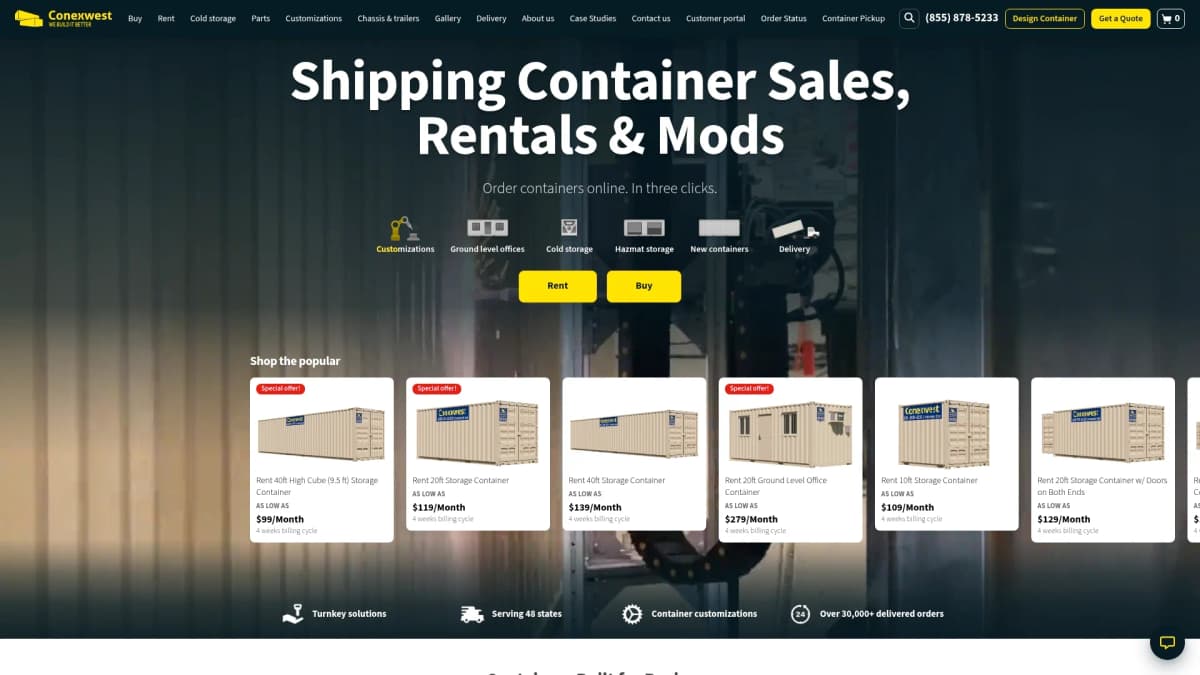
We have delivered more than 30,000 containers across 48 states, and we handle delivery, fabrication and pickup for rentals, so one team covers the whole job.
Our perspective: order the whole job, not just the box
The most common mistake we see is treating a container order as a product purchase when it is really a small logistics project. The box is the easy part. The cost and delay come from the address, the access and the intended use.
Three habits prevent most trouble. First, describe the use honestly. A container that will become an office or a cold room needs different specifications from one that holds pallets, and it is cheaper to say so at the start than to rebuild later. Second, give the delivery details early. A driver who knows about the slope, the gate and the soft ground arrives with the right equipment. Third, look at the local rules before the order is placed, because a permit question is much easier to answer before a container is sitting on the lot.
We turn modifications into a single order wherever possible, so that the unit arrives built to its purpose. For businesses with demanding timelines, such as retailers preparing for peak season or contractors mobilizing a site, that removes the second round of work.
— Conexwest
Frequently asked questions
Can I really order a shipping container entirely online?
Yes. You select purchase or rental, choose the container and any modifications, enter delivery details and submit the request. Because price depends on size, configuration and delivery address, the quote is built from your specific order, and a team member can confirm details before delivery is scheduled.
How much does it cost to have a container delivered?
Angi reports transport costs of $1,400 to $9,100, averaging about $3,000. Distance, location and access drive the difference. Giving the exact address and site conditions up front is the best way to get a delivery figure that holds.
Do I need a permit before ordering a container?
Often, yes, though it depends on your city or county and on the use. Storage may need an accessory-structure permit in some places, and offices generally must meet building code. Call your local building or planning department before you order.
What kind of ground does a container need?
A firm, level surface. Paved lots work well, and gravel pads are common on soft or uneven ground. The delivery truck also needs a clear approach and enough room to turn and unload.
Should I rent or buy?
Rent when the need has an end date, such as a construction phase, an event or a seasonal peak. Buy when the storage is permanent or when you plan significant modifications that you want to keep.
Sources
- How Much Does a Shipping Container Cost? | Angi
- Building Code Guide 96-11: Cargo Containers | City of Portland
- Information Bulletin: Cargo Containers for Incidental Storage | San Bernardino County
- Intermodal Shipping Containers Ordinance | Shasta County