
Owners: Make Containers Last 20–40 Years with Maintenance & Conversion
Shipping containers in active maritime rotation typically last 10 to 25 years before retirement from fleet service, while stationary units converted into storage or living space can last 20 to 40 years or longer with proper upkeep. The gap between those numbers comes down to three variables: environment, maintenance history, and how hard the unit has worked. A container pulled fresh from export duty and kept dry inland will outlast one that spent a decade on a coastal dock.
TL;DR:
- Containers in active maritime use typically last 10 to 25 years, while stationary or repurposed units with good maintenance can exceed 20 to 40 years.
- Salt exposure, moisture, and heavy usage significantly reduce lifespan, especially for containers placed in coastal environments or subjected to frequent handling.
- Proper inspection, timely rust repairs, and corrosion protection—such as coatings and stainless fasteners—are essential to extending container durability.
- Structural modifications for building conversions require engineering oversight, and floors treated with certain chemicals may need replacement for residential use.
- Routine maintenance, including repainting and seal replacement, can prevent costly repairs and signal when a container approaches the end of its economical service life.
Table of Contents
- Typical Lifespan Ranges: How Service History and Use Change Expectations
- Materials and Construction That Set the Baseline Durability
- Environment and Usage Factors That Accelerate Corrosion and Wear
- Inspection, Maintenance Checklist and Common Repairs That Add Years
- Container Homes and Permanent Repurposing: Code, Floors, and Structural Trade-offs
- Operational Perspective and Practical Steps From Conexwest
- Planning Advice: Budgeting, Lifecycle Decisions, and Replacement Signals
- How Conexwest Can Help You Extend Container Lifespan
- FAQ
- Sources
Typical Lifespan Ranges: How Service History and Use Change Expectations
A container’s working history shapes its remaining life more than its age on paper. Units in constant maritime rotation face repeated loading stress, salt exposure, and handling damage that shorten their functional window, while units pulled from active service and placed in stationary storage face a gentler set of conditions and can remain structurally sound for decades.
Manufacture date alone tells you little. A ten-year-old container that spent its life in dry inland storage can outperform a five-year-old unit that saw heavy ocean duty. The ISO/CSC plate riveted to the door frame records certification history and prior inspections, and it is worth checking before purchase. Repainting history also matters, since a well-maintained coating system slows the corrosion that eventually compromises steel panels.
- Active maritime containers in constant rotation: roughly 10 to 25 years of practical service.
- Stationary or repurposed containers with routine maintenance: 20 to 40 years or more.
- Prior damage, weld quality, and certification plates all shift these ranges up or down.
Materials and Construction That Set the Baseline Durability
Most shipping containers are built from Corten steel, a weathering alloy that forms a stable oxide layer when exposed to air and moisture. That layer acts as a barrier against further corrosion, which is why Corten holds up better than untreated carbon steel in many environments. Research on Corten performance shows that corrosion resistance varies by local conditions, including microbial activity in standing water or wastewater exposure, so the protective layer is not a guarantee against every environment.
The oxide layer only protects as long as it stays intact. Scratches, persistent moisture pockets, or chemical exposure can break down that barrier faster than normal weathering allows.
Beyond the steel panels themselves, a few components decide how long a container stays structurally sound:
- Corner castings, which bear the full stacking and lifting load and show stress long before panel steel does.
- Door frames and seals, where gasket failure lets moisture reach the interior.
- The floor, typically marine plywood, which absorbs moisture differently than the steel shell.
- Welds at seams and corners, where manufacturing quality varies across different builders and production runs.
Original build quality and any aftermarket repair work both factor into remaining life. A unit with documented professional weld repairs can perform as well as one with no damage history, while cosmetic patches over hidden rust often mask bigger problems.
Environment and Usage Factors That Accelerate Corrosion and Wear
Coastal and salt-air environments speed up corrosion more than almost any other factor. Salt particles settle on steel surfaces and on fasteners, breaking down protective coatings faster than inland weathering does. Urban pollution adds a similar effect through airborne chemical exposure.
Usage pattern compounds environmental stress. A container moved frequently, loaded with heavy or uneven freight, or exposed to repeated impact during transport wears down faster than one left stationary. Interior humidity, especially in units used for storage without ventilation, promotes rust from the inside out, often in spots that are hard to inspect without opening wall panels.
A few practical steps reduce that wear:
- Elevate the unit on a foundation or blocks to limit ground moisture contact.
- Add ventilation to reduce trapped interior humidity.
- Apply sacrificial coatings or touch-up paint on exposed seams.
- Choose stainless steel or thicker galvanized connectors for coastal placements, which corrosion-protection guidance identifies as a meaningful way to extend connector life and cut long-term maintenance costs.
Pro Tip: If you are placing a container within a mile of saltwater, budget for galvanized or stainless hardware upfront rather than replacing standard fasteners after corrosion sets in.
Inspection, Maintenance Checklist and Common Repairs That Add Years
Routine inspection catches small problems before they become structural ones. For containers still in active transport service, the Coast Guard requires documented periodic examinations, and CFR guidance sets a 30-month maximum interval for thorough examinations in some inspection regimes. That interval works as a reasonable benchmark even for stationary units, since it forces a documented look at structural points on a predictable schedule.
- Inspect corner castings, door seals, and floor edges for rust or deformation, and photograph findings for your records.
- Repaint exposed panels on a schedule tied to your environment, more frequently near the coast than inland.
- Replace worn door seals before moisture reaches the interior rather than after.
- Cut out and weld localized rust spots instead of painting over them, since trapped rust continues spreading under a coating.
- Address floor damage early, whether through sealing, partial replacement, or full plywood swap-out.
Pro Tip: Keep a simple inspection log with dates and photos. Baseline measurements make it far easier to tell whether a rust patch is new or stable.
Some repairs call for a professional rather than a DIY fix. Corner casting damage affects structural load paths and often requires certified welding, and non-destructive testing can confirm weld integrity on older units before you commit to a conversion. EPA inspection guidance for bulk storage containers makes a similar point: scheduled inspections paired with baseline measurements catch deterioration that a casual walk-around misses.
Container Homes and Permanent Repurposing: Code, Floors, and Structural Trade-offs
Converting a container into a home or office changes its structural math. Cutting openings for doors and windows removes load-bearing steel, and welding in reinforcement or insulation framing can trap moisture against bare metal if not detailed correctly.
Floors deserve particular attention. Standard marine plywood floors are chemically treated, and state guidance from Ohio’s Board of Building Standards flags these treatments as a material concern for residential conversions, recommending encapsulation or replacement before occupancy.
Code treatment varies by jurisdiction. Local construction standards note that containers are built to ISO and IMO conventions for transport, not for permanent occupancy, so converting one into a permanent structure typically triggers IBC or IRC review.
- Structural cuts require engineering review before fabrication begins.
- Floor treatment chemicals need disclosure or remediation for residential use.
- Permanent occupancy generally requires more documentation than temporary placement.
Operational Perspective and Practical Steps From Conexwest
Our experience delivering containers across many states has shaped how we think about durability from the first order. An online ordering system can let you select corrosion protection and structural customizations before delivery rather than retrofitting them later. Before accepting delivery, we recommend checking certification plates, inspecting for shipping damage, and confirming placement on a level, well-draining surface.
Planning Advice: Budgeting, Lifecycle Decisions, and Replacement Signals
Budget routine maintenance as an ongoing cost, not an afterthought: repainting, seal replacement, and spot rust repair are far cheaper than replacement. Watch for replacement signals instead of waiting for failure: structural rust through the base metal, compromised corner castings, or repeated hidden corrosion in the same area all signal the unit is past economical repair. Coastal owners face a different risk calculus than inland owners and should budget for more frequent inspection, while anyone converting a container to permanent use should engage a structural certifier before finalizing plans.
— Conexwest
How Conexwest Can Help You Extend Container Lifespan
Getting more years out of a container often comes down to choices made before delivery. Through our shipping containers for sale page, you can order fabrication and delivery services alongside the container itself, which means corrosion protection and structural upgrades get built in rather than added later.
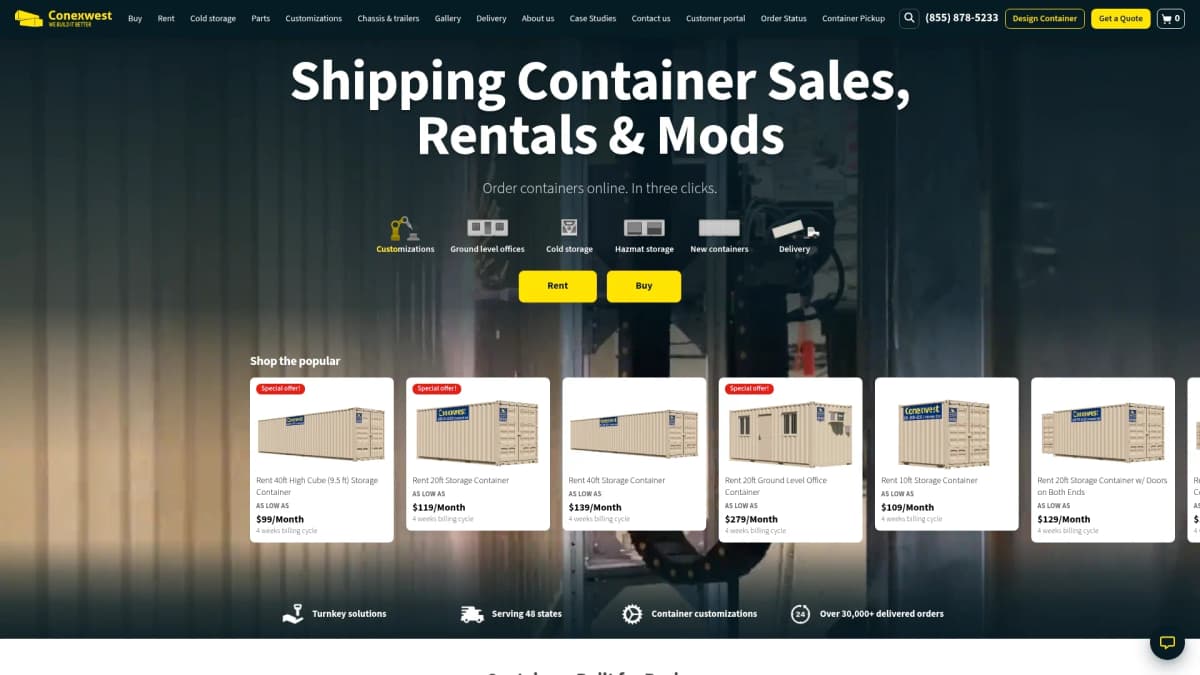
If you need modifications like upgraded coatings, insulation, or floor replacement, our container customizations services cover hazmat, cold storage, and office conversions. For short-term needs, storage containers for rent shift the lifecycle math since you are not responsible for long-term upkeep. Whichever path fits your situation, ask any provider about warranty terms, inspection documentation, and corrosion protection options before you commit, and reach out to us for a quote that fits your timeline.
FAQ
What is the longevity of a container home?
A well-maintained container home can last 20 to 40 years or more, similar to stationary storage units, provided the floor and structural modifications are handled correctly during conversion. Coastal placement, inadequate ventilation, or skipped maintenance can shorten that range significantly.
What is the ATO depreciation rate for shipping containers?
Depreciation schedules are a tax classification, not a measure of physical lifespan, and the applicable recovery period depends on your tax jurisdiction and how the container is used in business operations. In the United States, containers used in a trade or logistics operation are assigned a MACRS recovery period that does not reflect how long the container will actually remain usable.
Who is the No. 1 container company?
There is no single verified industry ranking for container suppliers, since companies vary by specialty, service area, and volume. We focus on online ordering with built-in customization options.
How long does it take to unload a 20,000 container ship?
This question concerns port logistics and vessel throughput, which falls outside container lifespan and maintenance topics. Unloading times depend on port infrastructure, crane capacity, and container volume, and vary widely by terminal.
Sources
- CFR §452.7 / §452.9 — Coast Guard periodic examinations guidance
- Ohio Board of Building Standards memo — Shipping containers
- Construction standards for shipping container conversion — Iredell County
- Corrosion protection for metal connectors and fasteners in coastal areas — Corpus Christi technical bulletin